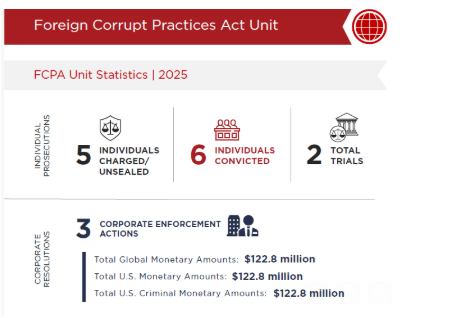
The Trump Administration’s Enforcement of the Foreign Corrupt Practices Act: Interim Report

On February 10, President Trump ordered a pause in the enforcement of the FCPA. His executive order claimed that its enforcement damaged American businesses while “impeding United States’ foreign policy objectives.” The order directed Attorney General Pamela Bondi to stop enforcing the act for 180 days to provide time to assess current enforcement policy and update the Department’s enforcement guidelines.

During the pause, some cases proceeded as normal. One FCPA defendant was sentenced and trials in three cases remained at least provisionally on track (here).

Other cases were derailed. One against two former executives of Cognizant Technology Solutions was dismissed, and several FCPA practitioners reported investigations they were handling were halted.

No official data on the number of investigations or cases dropped has been released, but there are insider reports.

Continue reading

Who Will Defend the FCPA?

Last month President Trump ordered Attorney General Bondi to “cease initiation of any new FCPA investigations or enforcement actions” while she determines whether the way the act is now enforced advances American interests. If she finds it is not, the Presidential Executive Order directs her to revise the current enforcement guidelines. In theory any revision will be driven by what an objective review finds; in fact Trump’s February 10 order has loaded the dice. It starts off proclaiming FCPA enforcement:

“has been systematically, and to an increasing degree, stretched beyond proper bounds and abused in a manner that harms the interests of the United States”

It continues:

“Overexpansive and unpredictable FCPA enforcement against American citizens and businesses … for routine business practices in other nations … wastes limited prosecutorial resources [and] actively harms American economic competitiveness.

These claims are patently false — as those who have watched the uptick in FCPA prosecutions or been involved in them know.  They must now speak up: To prevent Trump and Bondi from derailing one of the most successful efforts to fight global corruption since the international community made it a priority.

The list of witnesses is long. It includes not only American executives, lawyers, FBI investigators and federal prosecutors but the counterparts in countries rich and poor who have worked with them to curb the scourge of bribery. They need to present the “true facts” to Attorney General Bondi to counter the “alternate facts” in the Trump order.

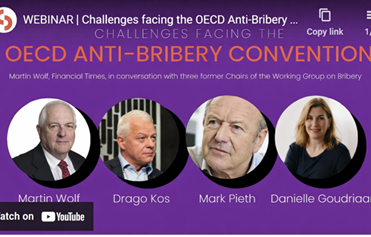
Already two former OECD General Counsels and three former chairs of its Working Group on Bribery have. In a February letter to Bondi they explain that the FCPA has advanced American interests by protecting “US companies from unfair practices by foreign companies” and they go on to provide additional evidence and reasons why FCPA enforcement policy requires little if any revision. Others need to go on record with stories of how and where enforcement measures helped American businesses and created good will for American interests generally.

Given Bondi’s unwavering fealty to Trump, the real facts are unlikely to stand in the way of her making drastic changes in FCPA enforcement, but changes will be subject to challenge in both a court of law and the court of public opinion. The more evidence on the record that that current enforcement policy advances American interests, the more likely any misguided revisions will be rejected.

Bondi has until August 9 to complete her review with the possibility of a 180 day extension. The sooner the true facts are on the record and the alternate ones revealed as half-truths existing in an alternate universe, the better. Submissions should be addressed to: The Honorable Pamela Bondi with the salutation Dear Attorney General Bondi: Her address:

  •  950 Pennsylvania Ave., N.W.
  •  Washington, D.C. 20530

GAB would be pleased to receive and share with readers copies of any submission.
TI USA: Attorney General’s Memorandum Redirecting U.S. Anti-Corruption Efforts Raises Questions and Concerns

Below is the statement TI US released today in response to Attorney General Bondi’s Memorandum directing federal prosecutors “to shift focus away from FCPA and FEPA investigations that do not involve” criminal cartels and transnational crime and disbanding DoJ’s KleptoCapture Task Force and Kleptocracy Asset Recovery Initiative. Enforcement of the Foreign Corrupt Practices Act has enjoyed broad, bipartisan support. Congress passed the Federal Extortion Prevention Act by a wide margin and has regularly approved funding for the KleptoCapture Task Force and the Kleptocracy Asset Recovery Initiative. GAB shares TI USA’s concerns about the Attorney General’s Memorandum and hopes she will reconsider it as supporters in Congress, the business community, and the anticorruption community make their concerns known.

Washington, DC—On February 5, 2025, Attorney General Pam Bondi circulated a Memorandum to U.S. Justice Department employees with the subject heading “Total Elimination of Cartels and Transnational Criminal Organizations.”

The Memorandum explains the outlined changes as a step toward implementing President Trump’s January 20, 2025, Executive Order entitled “Designating Cartels And Other Organizations As Foreign Terrorist Organizations And Specially Designated Global Terrorists.”

Among the changes are directives to (1) eliminate the KleptoCapture Task Force and the Kleptocracy Asset Recovery Initiative (KARI); (2) prioritize Foreign Corrupt Practices Act (FCPA) and Foreign Extortion Prevention Act (FEPA) investigations that are related to foreign bribery that facilitates the criminal operations of cartels and transnational criminal organizations (TCOs); (3) shift focus away from FCPA and FEPA investigations and cases that do not involve such a connection; and (3) remove the “bureaucratic impediment” requiring that investigations and prosecutions under the FCPA or FEPA regarding foreign bribery associated with cartels and TCOs first be authorized by, as well as conducted solely by, the Criminal Division and the Fraud Section, respectively, of the Department of Justice in Washington, D.C.

Transparency International U.S Executive Director Gary Kalman issued the following statement:

Continue reading

U.S. Prosecutors Newest Addition to Their Anticorruption Toolkit

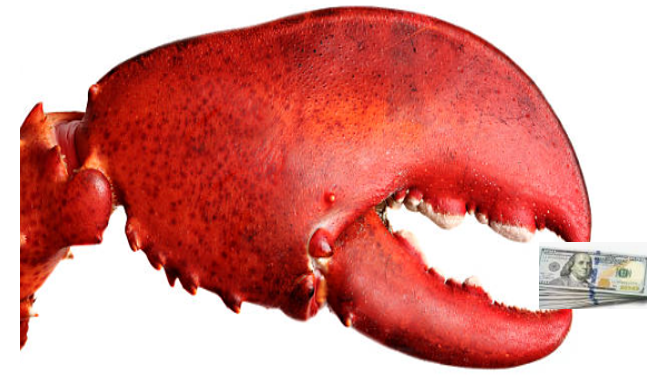
For more than three decades the U.S. Justice Department has sought ways to pressure American corporations to police their executives, employees, and consultants. To see that they take measures to see those they employ don’t pay bribes, rig prices, or commit other crimes. Shown above is pictorial representation of its latest tool.

It shows a crab gripping a stack of hundred dollar bills with its claw. That is precisely what the Justice Department expects a corporation to do if it discovers someone in its employ has paid a bribe, fixed a price, or committed another serious crime to advance the corporation’s interest. The company is to clawback monies paid the miscreant.

Continue reading

The Goldman Sachs 1MDB Settlement Was Just and Appropriate

In late October, the United States Department of Justice announced a major settlement with the global investment bank Goldman Sachs for its involvement in the 1MDB scandal, an international bribery scheme in which high-level Malaysian officials embezzled an estimated $4.5 billion from a fund designed to finance infrastructure and other economic development projects. Between 2012 and 2013, Goldman Sachs helped raise $6.5 billion for 1MDB in three bond sales, and at least two Goldman bankers aided Jho Low, an advisor to the fund, in embezzling much of the capital. As part of the settlement with DOJ, Goldman agreed to pay over $2.9 billion to authorities in the US, Hong Kong, UK, and Singapore. Of the nearly $3 billion in fines, approximately $1.85 billion will go to the United States, over $600 million to Malaysia (on top of a $3.9 billion settlement the Malaysian branch of Goldman reached with the country in July), and $440 million to financial regulators in other nations.

Despite these eye-popping numbers—including what appears to be the largest fine to date levied under the U.S. Foreign Corrupt Practices Act—some experts have characterized the $2.9 billion penalty as “surprisingly small” or even “virtually meaningless” for a company that made $3.6 billion this last quarter alone. And, in what has become a common refrain among critics of these sorts of settlements with big firms, many complain that no senior Goldman Sachs executives were held personally, criminally liable for the bank’s role in the 1MDB fiasco.

Yet an assessment of the punishment must also include the penalties that extend beyond these government-imposed fines. Indeed, while some regard Goldman Sachs’ settlement as a slap on the wrist for a global corporation that’s a glutton for punishment, the implications of the settlement reveal a more just outcome than appears at first blush.

Continue reading

Memo for SEC Chairman Clayton: Getting Other Nations to Enforce Their Antibribery Laws

In recent remarks to the New York business community, you complain that vigorous enforcement of the Foreign Corrupt Practices Act has had little effect on corruption levels “in many areas of the world.”  The blame, you argue, lies with other nations which don’t enforce their antibribery laws. When companies from these nations seek business in a third state, they are free to, and too often do, bribe their way to commercial success. Indeed, as you explain, their repeated success provides the states where they are headquartered an incentive not to enforce their antibribery laws.

Using the prisoners’ dilemma game, you show that bribery will only be brought under control when all countries with firms that do business in foreign states agree to crack down on the payment of bribes.  And you promise that whenever you speak to counterparts in these countries, you will try to persuade them of the value of “common, cooperative enforcement strategies.”  But while the prisoners’ dilemma paradox underscores why all countries where firms that may pay bribes are located must enforce their antibribery laws, it obscures another important step in the global fight against corruption. One that the Commission can do much to advance.    Continue reading

Too Many Cooks in the Kitchen? Why Commodity Futures Trading Commission’s New Anticorruption Enforcement is Not Superfluous

In March 2019, the Commodity Futures Trading Commission (CFTC)—the US federal regulator of commodity markets—issued a new Enforcement Advisory concerning foreign bribery in the commodities sector. According to the Advisory, the CFTC will presumptively decline to pursue civil monetary penalties against parties that timely and voluntarily self-report acts of foreign corruption that would otherwise violate the Commodities Exchange Act (CEA), so long as the self-reporting party fully cooperates, provides appropriate remediation, and there are no other aggregating factors. Of course, this Advisory implies that when these conditions are not satisfied, the CFTC will seek to impose sanctions in foreign bribery cases. And indeed, only a couple of months after the Advisory was published, the CFTC informed Glencore, a Swiss mining and trading company, that it was being investigated for corrupt practices that violated the CEA. The CFTC’s new Advisory and the Glencore investigation are a wakeup call for all market participants, especially broker-dealers and future commission merchants, that the CFTC is serious about cracking down on foreign corruption in the commodity trading sector.

This is notable because typically we think of the US addressing foreign bribery through the Foreign Corrupt Practices Act (FCPA), which is enforced by the Department of Justice (DOJ) and the Securities and Exchange Commission (SEC). Yet while bribing foreign officials would indeed violate the FCPA, such conduct could also amount to violations of the CEA or its implementing regulations whenever commodity prices in the US are affected by the foreign corrupt practices: in such cases, the bribery could qualify as a form of prohibited fraud, false reporting, or market manipulation. For example, a commodities trader could violate CFTC regulations if it uses bribes to secure swaps or derivative contracts. Likewise, a company that paid bribes to foreign officials for purposes of monopolizing crude oil production in order to increase the commodity price and manipulate benchmarks for related derivative contracts would be in violation of the CEA’s anti-manipulation provision. The possibility of CFTC enforcement raises concerns about “piling on,” with duplicative penalties levied by separate US agencies for the same underlying conduct, but to address that concern CFTC Enforcement Director James McDonald has emphasized that the CFTC would “will give dollar-for-dollar credit for disgorgement or restitution payments in connection with other related actions.”

Of course, that only raises another question: Why not just leave the foreign bribery problem to the DOJ and SEC to address through FCPA enforcement actions? Does CFTC enforcement in the foreign bribery context really add any value? The answer to that latter question is likely yes, for at least two reasons:

Continue reading

Why the WTO Should Tackle Border Corruption

When a state systematically fails to suppress bribery in its customs service, should that be an actionable violation of international trade law? More broadly, to what extent do anticorruption provisions have a place in the law of the World Trade Organization? In a 2014 post on this blog, Colette van der Ven squarely addressed these questions and concluded that the answer is no: the WTO, in her view, is not well suited to handling complaints of corruption.

I disagree with Colette’s well-reasoned analysis. While she is right to point out substantial challenges to grappling with anticorruption through the WTO, these challenges are surmountable—and the importance of a WTO remedy counsels in favor of surmounting them. Continue reading

A Plan To Share FCPA Penalties with Brazil has Been Thwarted… by Brazil: The Supreme Court’s Invalidation of the Lava Jato Foundation

A frequent criticism of how the US Department of Justice (DOJ) enforces the Foreign Corrupt Practices Act (FCPA) is that the fines recovered typically go to the US Treasury, rather than being used to make reparations for the damages caused by corruption in the countries where the bribery took place. Those who hold that view were likely encouraged by the non-prosecution agreement (NPA) that the DOJ concluded with Petrobras, the Brazilian state-owned oil company, in September 2018. The US enforcement action against Petrobras is a development of the so-called Lava Jato (Car Wash) investigation, in which firms paid off some Petrobras’ senior employees to benefit them in the contracts they had with the oil company. Such senior employees also shared a portion of the briber of politicians and political parties. In Brazil, Petrobras (and its shareholders, including the Brazilian federal government) are considered the victims of this scheme, but the US DOJ considered Petrobras a perpetrator (as well as a victim), because Petrobras officials had facilitated the bribe payments, in violation of the FCPA. Thus, the DOJ brought an enforcement action against Petrobras, and the parties settled via an NPA that required Petrobras to pay over US$852 million in penalties for FCPA violations. But—and here is the interesting part—the NPA also stated that the US government would credit against this judgment 80% of the total (over US$682 million) that Petrobras would pay to Brazilian authorities pursuant to an agreement to be negotiated subsequently between Petrobras and the Brazilian authorities.

This unusual agreement was the result of unusually close cooperation between U.S. and Brazilian authorities, especially the Lava Jato Task Force (group of federal prosecutors handling a series of Petrobras-related cases). After the conclusion of the NPA between the DOJ and Petrobras, the Task Force then entered into negotiations with Petrobras and reached an agreement under which Petrobras would use US$682 million that it would otherwise owe to the US government to create a private charity, known unofficially as the Lava Jato Foundation, with the Foundation using half of the money to sponsor public interest initiatives, and the other half to compensate minority shareholders in Petrobras. According to the agreement, the Foundation would be governed by a committee of five unpaid members from civil society organizations, to be appointed by the Task Force upon judicial confirmation. Once created, the Task Forcewould have the prerogative to have one of its members sitting at the Foundation’s board.

This resolution of the Petrobras case seemed to be a win-win resolution and a promising precedent for future cases: The US imposed a hefty sanction for violation of US law, but most of the money would be used to help the Brazilian people, who are arguably the ones most harmed by Petrobras’s unlawful conduct. Yet this arrangement has proven extremely controversial in Brazil, both politically and legally. Indeed, the issue has divided the country’s own federal prosecutors: The Prosecutor General (the head of the Federal Prosecutor’s Office, from which the Lava Jato Task Force enjoys a broad independence) challenged the creation of the Foundation as unconstitutional. She prevailed on that challenge in Brazil’s Supreme Court (Supremo Tribunal Federalor STF), which suspended the operation of the Foundation.

What, exactly, was the legal argument against the creation of the Lava Jato Foundation, and what are the implications of the STF’s ruling for this approach to remediating the impacts of foreign bribery going forward?

Continue reading

Complying with Antibribery Laws: Mike Koehler’s Strategies for Minimizing Risk Under the FCPA and Related Laws

Professor Mike Koehler is perhaps the leading critic of the Foreign Corrupt Practices Act – or at least of how the U.S. Justice Department and Securities and Exchange Commission currently enforce it.  On his FCPA Professor Blog, he regularly bemoans the way the enforcement agencies have stretched a law its authors wrote to outlaw hard core bribery to make donations to foreign charities, internships for relatives of business associates, birthday gifts to business partners, and other seemingly innocuous  conduct a serious felony under American law. Such broad interpretations of the law’s antibribery stricture could never withstand judicial review he argues, but because the costs, reputational and otherwise, of challenging an FCPA enforcement action are so great, companies facing FCPA charges quickly settle rather than contest the agencies’ interpretation in court.  The result is the agencies not only enforce the law but their interpretations in effect make it as well.

So what advice does Professor Koehler proffer businesses wanting to avoid running afoul of the FCPA or the similar laws of other nations in his new book Strategies for Minimizing Risk Under the Foreign Corrupt Practices Act and Related Laws?  Does he urge a corporation threatened with an enforcement action based on an overly broad reading of a law to fight back?  Has he produced a polemical guide to compliance?  One written for the risk-taking corporate maverick?  Is this how he separates his book from the many other compliance guides flooding the market?

Not at all. To the contrary, what distinguishes Professor Koehler’s book from many of its competitors is its straightforward, easy to read exposition of what any firm should do to minimize the chances that, thanks to the wayward act of an employee or consultant, it will face allegations it has bribed a government official. In eight tightly-written chapters, he brings his encyclopedic knowledge of FCPA cases, pre-trial settlements of enforcement actions, and the commentary on antibribery law to bear to explain how to develop and implement a sound, reasonable, cost-effective antibribery compliance program. Along the way he chucks the jargon that has grown up around antibribery compliance programs, opting instead for clearly written prose that demystifies rather obscures the process all firms should follow to develop and implement preventive measures.

Take his account in chapter six on how to conduct a risk assessment. Continue reading