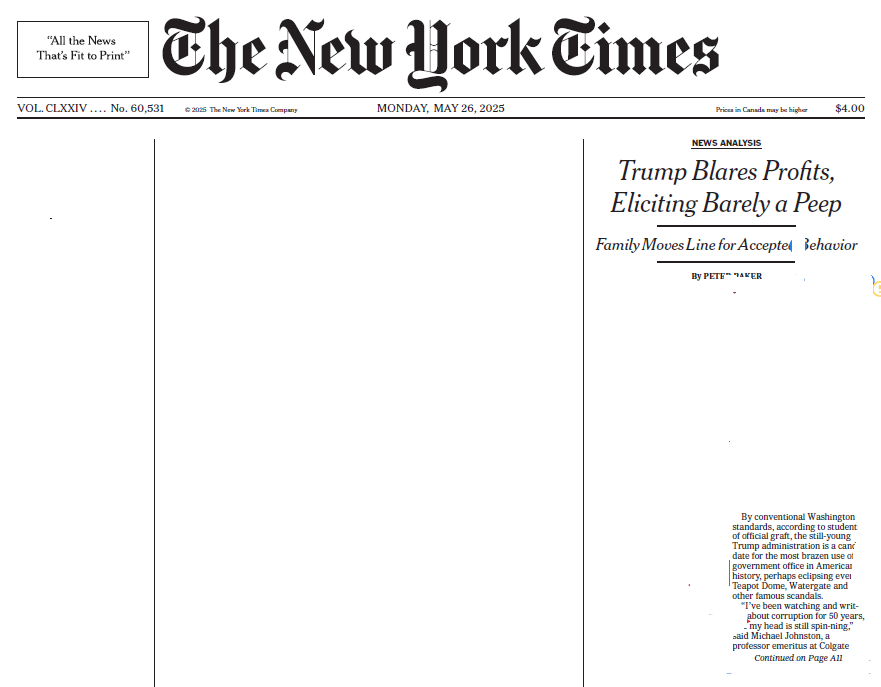
Trump Blares Profits, Eliciting Barely a Peep

That was the headline on the lead story in the May 26 New York Times.

The author, the chief White House correspondent for The New York Times and one of Washington’s most respected journalists, reports the growing view that the Trump Administration’s corruption represents “the most brazen use of government office in American history.” In support he cites anticorruption guru and GAB favorite Michael Johnston who told him–

I’ve been watching and writing about corruption for 50 years, and my head is still spinning

To quote a guru on another subject (revolution — V. Lenin), the question is now: What is to Done?

Belgian and Uzbek Governments Profit from Termination of DoJ’s Kleptocracy Unit

Central Asia Due Diligence and the Uzbek Forum for Human Rights have identified the latest fallout from the Trump Administration’s destruction of American institutions devoted to fighting global corruption. The governments of Belgium and Uzbekistan have each pocketed $108 million in stolen assets that should have gone to the people of Uzbekistan.

In this just released paper, the two human rights NGOs explain how the demise of the Department of Justice’s Kleptocracy Asset Recovery Initiative allowed the two governments to ignore provisions in the UN Convention Against Corruption and the principles of the Global Forum on Asset Recovery that together bar assets stolen by a corrupt official from being kept by the government of the country where the official stashed them or returned to the official’s corrupt cronies.

Lawyers for the Initiative had designed a sophisticated process (details here) to see the $216 million in bribes to former Uzbek first daughter Gulnara Karimova found in Belgian banks DoJ would go to the UN trust fund overseeing development programs in Uzbekistan. With the Initiative’s demise, the Belgian and Uzbek governments apparently saw no reason they should not divvy up the money between them.

So thanks to the Trump Administration, Belgium, one of the world’s wealthiest countries, is now $108 million wealthier, and Uzbek’s leaders, several Gulnara’s accomplices, now have $108 million to spend keeping themselves in power. Meanwhile, the citizens of Uzbekistan, GDP per capita $3,500, scrape by.

The Anticorruption Legacy of American Civil Service Reform

In the waning months of President Donald Trump’s first term, he issued an executive order that could have drastically reshaped the U.S. federal bureaucracy. The order created a new federal government job classification with far fewer civil service protections, called “Schedule F.” While most career civil servants in the U.S. federal government are protected from politically motivated firings and cannot be fired without cause, under Schedule F, employees “of a confidential, policy-determining, policy-making, or policy-advocating character” could be fired without following standard civil service procedures. With Trump now set to reassume power, Schedule F is back on the table, threatening to take away employment protections from potentially hundreds of thousands of federal employees and making it easier to fire civil servants for purely political reasons.

Commentators have pointed out the potential negative effects of Schedule F on administrative capacity, government performance, and accountability. But another key reason to be skeptical of Schedule F is that it represents a step backwards in the history of American civil service reform, which has its roots in 19th century anticorruption movements. Civil service independence and merit-based hiring came about in response to endemic corruption in the federal bureaucracy. The anticorruption history of the American civil service holds important lessons for modern civil service reformers, both in the United States and elsewhere.

Continue reading

Will America’s Anticorruption NGOs Hold Trump II to Account?

If the trend Daniel Schuman identifies in “Open-Government Nonprofits Are Dying Off Just When They’re Needed Most,” the answer is a clear if frightening NO (here). Schuman, Executive Director of the American Governance Institute, ticks of a list of U.S. watchdogs closing their doors or drastically cutting staff thanks to multiple funding crises.

Those now on the block include: OpenSecrets, which for years has shown which politicians get money from what special interests; OMB Watch, a pioneer in unearthing hard-to-find data on government spending; and the Center for Public Integrity, the scourge of those officials who have never seen an ethical line they can’t cross.

Why, just when more eyes are needed on Trump and cronies, are those with 20-20 vision finding it so hard to raise money? Schulman puts it off to the polarization now infecting the American body politic. The foundations and high-net-worth individuals that have traditionally backed organizations dedicated to “public-informing, community-building work” have, he writes, become “auxiliaries for the parties in their trench warfare over political power.”

Bad enough the funding drought coincides with the return of an Administration likely to make Grant’s second term seem a model of probity. Many of those on the ropes have done much to advance the global war on corruption, from serving as models for citizens of other nations to providing critical technical assistance to anticorruption NGOs around the globe. The fight against corruption in the U.S. is entering a critical phase with the outcome likely to affect the fight in other nations. The stakes couldn’t be higher. Will donors please reconsider their decisions?

Thanks to TheBulwark, an indispensable source for what’s happening in the U.S., for publishing Schuman’s story.

Corruption as a National Security Priority: How Will it Shape U.S. Policy in Fragile States?

Corruption has increasingly been framed as a national security priority in United States policy. This is perhaps most readily apparent in the National Security Council’s 2023 U.S. Strategy on Countering Corruption, but it is also manifest in several major pieces of legislation. One such legislative initiative is the 2019 Global Fragility Act (GFA), which tasked the State Department, Department of Defense (DoD), and US Agency for International Development (USAID) with developing a coordinated ten-year strategy for preventing conflict in fragile states. This past March, the State Department published its inaugural Strategy for Preventing Conflict in four pilot countries—Libya, Mozambique, Haiti, and Papua New Guinea—and one region, Coastal West Africa (encompassing Guinea, Cote D’Ivoire, Ghana, Togo, and Benin). Each of these strategy documents center anticorruption reform as a means to improve state legitimacy and reduce the risk of conflict, but they take quite different approaches to addressing the problem of corruption within a national security framework. Continue reading

Trump Indictment’s Lesson for Prosecutors Charging Senior Political Figures

At long last federal prosecutors have filed charges against former President Donald Trump for crimes arising from his unlawful possession of classified documents. The charges are contained in what is called an indictment in the United States.

One aspect of the indictment merits the attention of prosecutors everywhere. Or at least for those considering charging senior government officials or ex-officials who, like Trump, can be expected to try to sway public or elite opinion by any means to escape convictions.

The Trump indictment is what American prosecutors call a “speaking indictment.”

Continue reading

Trump’s Attempted Coup Explained

That Donald Trump egregiously abused his power as president in the closing days of his term in office there is now no doubt. Pressuring and threatening election officials and inciting a mob to storm the U.S. Capitol make out abuses that rival if they do not exceed those of America’s most corrupt leaders.

Thanks to the testimony of former Trump officials before the House committee investigating the Capitol riot, we now know the abuses were part of the most serious crime ever attempted against the government of the United States of America and its people: a plot to install Trump as president on January 20, 2021, despite that fact he had lost the election. Trump and accomplices attempted a coup d’état that only just failed.

Americans and democracy’s friends everywhere may find it hard to accept that American democracy narrowly survived a coup d’état. Coups happen in poorer countries with weak governments, not in one of the wealthiest nations in the world with a democracy that has weathered civil war and countless violent demonstrations. But the details that have been exposed, most recently the dramatic, chilling testimony of former White House aide Cassidy Hutchinson, make it clear there is simply no other term that fits.

For those who have not followed the House committee’s work, or who may have but still resist labelling the actions of Trump and accomplices a coup, its broad outlines are described below.

Continue reading

Rethinking Presidential Obstruction of Justice

One of the greatest powers that can be granted to a national chief executive is jurisdiction over law enforcement. From the French President’s authority over the Ministry of Justice to the American President’s authority over the Department of Justice (DOJ), a number of states entrust their chief executive with significant control over the nation’s top law enforcement bodies. While these oversight powers are often exercised to achieve legitimate aims, problems arise when an executive uses his authority to shield himself or his associates from legal accountability. Such misuse of the chief executive’s authority over law enforcement is itself corrupt—an abuse of the president or prime minister’s public power to protect his private interests—and can foster the culture of impunity that allows other forms of corruption to thrive. But policing this sort of improper interference is challenging.

One possible limit on corrupt presidential interference with law enforcement is the fact that such interference may itself be a crime. In the United States, for example, it is a felony—known as “obstruction of justice”—for a government official to “corruptly” use the power of his or her office to “obstruct” a “pending or contemplated official proceeding” (such as a trial or investigation). But as Special Counsel Robert Mueller’s investigation into former President Donald Trump made clear, the current version of the obstruction of justice statute may be inadequate to check this form of presidential corruption.

For starters, it’s not clear whether the obstruction of justice statute, as currently written, even applies to a sitting president. (Scholars have disagreed on this point, with some arguing that the current statute does not apply to the president—see here and here—and others arguing to the contrary that it does.) That problem, though, has an easy fix: As Bob Bauer and Jack Goldsmith’s recent book has argued, Congress can and should amend the statute to state explicitly that a sitting president can commit obstruction of justice. Another difficulty is that, as Robert Mueller’s report stressed, under current DOJ policy, a sitting president cannot be criminally indicted. This too could be changed. The deeper and harder problem is that because in the U.S. system the president may legitimately seek to influence the conduct of criminal investigations, and because the president’s motives may be ambiguous or mixed, it is very hard, perhaps impossible, to prove that the president’s actions with respect to a pending or contemplated official proceedings were “corrupt.” Take President Trump’s decision to fire FBI Director James Comey. The Mueller Report concludes that President Trump fired Director Comey to save his presidency (which seems like a corrupt motive). Yet some claim that President Trump also had other, more legitimate reasons for firing Director Comey, including concerns about partisan bias in Comey’s investigations. And even if one contests that claim in this particular case, it’s not hard to imagine a situation in which a President moved to impede an investigation that both threatened the president’s personal interests and that the President thought was unwise or improper.

How should the law treat such cases, if the goal is to ensure that a U.S. President is not above the law, while simultaneously giving the President appropriate latitude oversee federal law enforcement?

Rethinking the Hatch Act in a Post-Trump World

In the United States, the Hatch Act has long served as bulwark against the corrosive intersection of partisan politics and government power. Signed into law in 1939, the Hatch Act was designed to combat the corruption associated with the so-called “spoils system,” in which politicians dole out valuable government jobs to their supporters, and those supporters are in return expected to use their government positions to benefit their political patrons. Civil service laws that create a “merit system” attack the spoils system from one direction, by making politically-motivated hiring and firing more difficult. Laws like the Hatch Act complement these efforts by prohibiting government employees from engaging in partisan political activities. More specifically, the Hatch Act prohibits any federal officer or employee (other than the President or Vice President) from engaging in political activity while acting under his or her “official authority or influence.” (This prohibition, as interpreted, covers any sort of partisan political activity while on the job, including displaying political paraphernalia, distributing campaign materials, and soliciting campaign contributions.) Penalties for violating the Hatch Act can include fines, demotion, suspension, removal from office, and temporary debarment from future federal service.

Since its enactment, compliance with the Hatch Act has generally been quite good. But that changed in January 2017, when President Trump took office. Throughout the Trump years, rampant violations of the Hatch Act plagued the federal government. High-level Trump Administration officials like Ivanka TrumpJared KushnerMike PompeoKellyanne Conway, and Stephen Miller, among many others, engaged in likely Hatch Act violations, with no significant consequences. This exposed an uncomfortable truth: At least for high-level political appointees, the Hatch Act’s enforcement mechanisms are too week, and the penalties too negligible, to deter officials uninterested in complying with the law. Indeed, past compliance with the Act was likely more the product of government norms than fear of punishment.

Just to be clear, the situation is likely quite different for career civil servants who serve in government regardless of which political party holds the White House. With respect to these individuals, who comprise the overwhelming majority of the government, the Hatch Act’s prohibitions are strictly enforced, and the penalties are stiff. But for senior political appointees, the Trump Administration exposed glaring weaknesses in the Hatch Act’s efficacy, when the Administration has little interest in adhering to conventional norms of ethics and integrity. Two types of reform are needed:

Continue reading

The Emoluments Clause Cases Against Donald Trump: A Post Mortem

Of the many credible corruption and conflict-of-interest allegations against former President Donald Trump, some of the most prominent concerned the income that the Trump Organization earned from parties with interests in influencing U.S. government policy. While the general conflict-of-interest rules that cover most federal officials do not apply to the President, a subset of the Trump Organization’s business dealings—in particular, those involving foreign governments and state governments—at least arguably violated the U.S. Constitution’s two so-called “Emoluments Clauses. (The Foreign Emoluments Clause prohibits any U.S. official from receiving gifts, titles, or “emoluments” from foreign governments, while the Domestic Emoluments Clause prohibits the President in particular from receiving any benefits other than his official salary from federal, state, or local governments.) President Trump’s alleged violations of the Emoluments Clauses triggered three separate lawsuits, filed by different parties in different federal courts, within Trump’s first six months in office. Those cases gradually wound their way through the legal system, with some defeats and some victories, mainly on threshold legal questions.

Last week, the U.S. Supreme Court brought that whole process to a halt, dismissing petitions for review in two of those pending cases as moot. (The third case had been dismissed by an appeals court, and the Supreme Court declined to review that case last fall.) Thought the Court’s terse, unsigned order included no explanation, the obvious inference is that the Court determined that the Emoluments Clause suits were moot because Donald Trump is no longer President. Importantly, the Court’s mootness order means not only that these suits won’t proceed, but also that the previous legal rulings in the cases under review are vacated, and thus have no precedential value. Legally speaking, it’s as if the cases never happened.

This did not sit well with everyone. Former head of the Office on Government Ethics Walter Shaub described the Court’s dismissal of the cases as “insane,” arguing that the cases are “not moot” because Trump “still has the money.” “When any other federal employee violates the emoluments clause,” Shaub observed, “they have to forfeit the money.” Others involved in the litigation against Trump tried to look on the bright side. The Citizens for Responsibility and Ethics in Washington (CREW), for example, issued a statement noting that the Emoluments Clause litigation “made the American people aware for four years of the pervasive corruption that came from a president … taking benefits and payments from foreign and domestic governments.”

I’ve been trying to figure out what I think about all this. I don’t have a clear, clean bottom line, but I do have a few scattered thoughts about what we might take away from the denouement of the Emoluments Clause controversy. Continue reading