Guest Post: Towards Truly Global Anticorruption Enforcement

GAB welcomes this Guest Post by Noam Kozlov, an honors graduate of Hebrew University with an undergraduate degree in Economics and Philosophy and an LL.B. A clerk for Israeli Supreme Court Justice Yosef Elron during the 2024/2025 term, he is now pursuing an LL.M. at the Harvard Law School.

For decades, the United States has spearheaded the global fight against transnational corruption. Its Foreign Corrupt Practices Act, the first statute to outlaw foreign bribery, led directly to the 1997 OECD Anti-Bribery Convention which requires all wealthy nations to outlaw foreign bribery. The US has also been the leader in prosecuting foreign bribery cases, bringing more than the rest of the world combined.

The Trump administration’s February 2025 pause in FCPA enforcement, and subsequent new policy narrowing its scope, have created a crisis in the enforcement of this fundamental global anticorruption norm.  What nation has the reach and the resources to take over from the US?

At the same time, there could be a bright edge to the shadow cast by the US retreat. The crisis could force the international community to move away from reliance on a single dominant country and toward a more equitable model of enforcement, one based on shared responsibility through prioritizing the sharing of proceeds and empowering institutions in nations where bribes were paid; an approach that would advance the restitutive objectives of anticorruption enforcement more effectively than the US-centric model ever could.

Continue reading
Guest Post: Public Debt Confidentiality — Separating Fact from Fiction

In this guest post, Erin Houlihan, Senior Program Director with the National Democratic Institute, reviews the relationship between confidentiality clauses and hidden debt, and highlights insights and recommendations from the publication. It is drawn from a new brief,developed by Richard Christeland co-published by NDI, OGP and TI, examining the problem of secrecy clauses in sovereign debt agreements and debunking the most common fictions used by lenders and borrowers to justify their use.

The UNCTAD Secretariat calls the current global debt crisis “one the biggest threats to global peace and security and financial stability” facing the world today. By 2030, global public debt is predicted to reach 100 percent of GDP. Unfortunately, the situation is probably worse than the data indicate. 

The problem of hidden debt – meaning debt hidden from both a nation’s citizens and its creditors – is a consistent and “remarkably pervasive” feature of the world’s sovereign debt crisis and one invariably the result of corruption. It is the citizens of borrowing states – mainly Low and Middle Income Countries (LMICs) – who pay the price when the debt is discovered: increased taxes and fewer public services as governments slash social spending on health, education and other public goods to cover borrowing costs. 

In Mozambique, for instance, the revelation of over USD 2bn in hidden debt prompted the IMF to withdraw aid in 2016, triggering a financial crisis, sovereign debt default, and currency collapse. More recently, a 2024 audit in Senegal revealed billions of dollars in hidden debt from the previous government, throwing the country’s governance credibility and financial future into disarray. 

Why is hidden debt so pervasive and what contributes to non-disclosure?

Continue reading

Did Australia Just Set a Record for the Lowest Fine in a Foreign Bribery Case?

Sydney Morning Herald correspondent Nick McKenzie reports that David Savage, former CEO of the Australian infrastructure giant Leighton Holdings, pled guilty January 30 to covering up the payment of $45 million to corrupt Iraqi politicians (here).

The fine: AUD $1000. About $700 in U.S. dollars.

The possibly record setting fine didn’t escape Australian anticorruption activists’ notice. McKenzie quotes Clancy Moore of Transparency International:

This minuscule fine for a huge multimillion dollar bribery scandal is embarrassing and sends the wrong message to Australian businesses working in high-risk industries like infrastructure and mining,”

The story is behind a paywall. For those without an SMH subscription some especially damning facts include —

Continue reading

Independent Expert Report on Honduras Dam Links Human Rights Violations and Systemic Corruption

Naomi Roht-Arriaza, Distinguished Professor of Law (emeritus), University of California Law, San Francisco, and author of what this writer called an indispensable guide to combatting corruption, contributes the following post. As with her book, it shows the often close link between corruption and human rights violations.

On the night of March 2, 2016, armed men broke into Berta Cáceres’ home, shot her dead, and wounded her house guest.  Cáceres was well known in Honduras and globally for her opposition to a proposed hydroelectric project damming the Gualcarque river, sacred to her Lenca indigenous people.  The triggermen and the project president were eventually convicted of the murder, but not the masterminds and financial backers, thought to include military officers and powerful families.  After long delay, the fraud behind the dam project, known as Agua Zarca, did finally go to trial, and some (but not all) of those responsible were convicted of fraud, falsification of documents and abuse of authority. 

After years of insisting on a full accounting, victims’ groups working with the Inter-American Commission on Human Rights convinced the Honduran government to ask for technical assistance in the form of an expert committee to look at the interplay of corruption, rights violations and corporate irresponsibility surrounding the dam and the murder.  That expert committee has now issued its report (in Spanish only, with English Executive Summary here).

The investigation and report break new ground. 

Continue reading

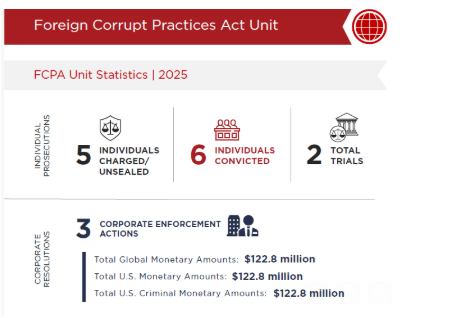
FCPA Enforcement Data 2025

The graphic is from the 2025 report of the Department of Justice’s Fraud Section. Hard to draw any conclusions about the impact of the Trump Administration’s downgrading FCPA enforcement as the cases largely reflect work begun in Biden Administration and earlier.  Perhaps the fact FCPA cases yielded $122.8 million, far in excess of what it cost to prosecute them, will lead Trump Administration officials to reconsidere cutbacks in FCPA enforcement actions

Link to the full report here.

Power, Corruption, and Us: Why Do We Choose the Political Leaders We Do?

GAB welcomes this post by Greysa Barrientos Núñez, a Costa Rican prosecutor with 27 years’ experience investigating and prosecuting financial and corruption-related crimes. She is a member of Norway’s Corruption Hunters Network.

One of the most uncomfortable, but necessary questions in political life is not what decisions those who govern make, but why is it that they come to govern. Political scientist and academic Brian Klaas argues that the most fundamental questions of a society must be directed at who seeks power, who obtains it, and how power transforms the person who exercises it.

There are several explanations that, far from excluding one another, complement each other. One holds that power corrupts; another, that corrupt people are especially drawn to power and are often better at obtaining it; a third points to society, which tends to hand power to bad leaders for the wrong reasons; a fourth shifts the focus to systems, arguing that poorly designed institutional contexts reward the worst behaviors.

Continue reading