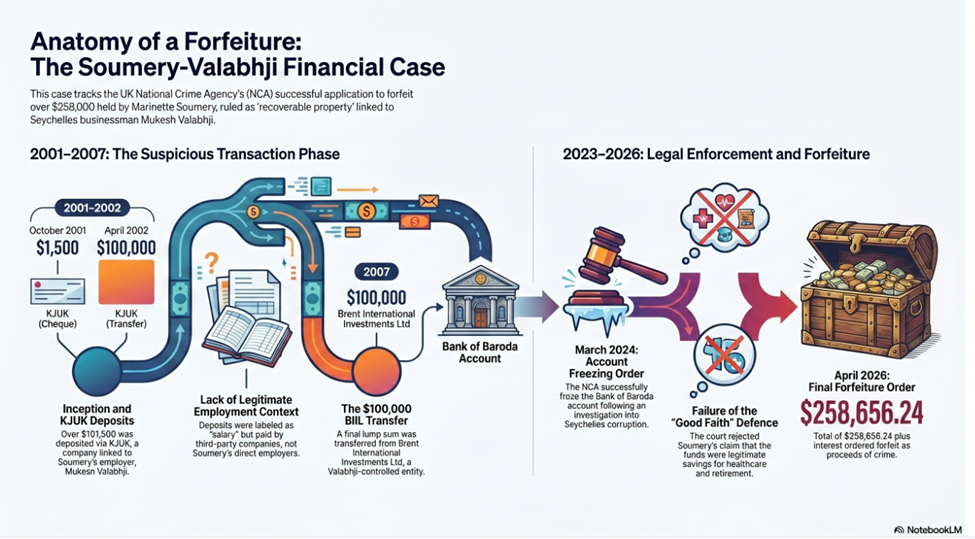
U.K. Magistrate District Judge Sam Goozée ruled April 22 that the statute of limitations in a civil forfeiture starts to run only when the National Crime Agency learns of the existence of the assets and their illegal origin (here). As a result, he ordered the forfeiture of some $260,000 in the London bank account of Marinette Soumery, a secretary of Mukesh Valabhji, a former Seychelles government official charged with 11 counts of corruption, abuse of authority of office and money laundering (here).
In its forfeiture application, the NCA linked the money to companies and individuals associated with Valabhji and showed he and Soumery had taken elaborate steps to disguise its source. Because of the “highly suspicious” actions taken to hide where the funds came from, their links to Valabhji and associates, and Soumery and Valabhji’s inability to offer a credible explanation for their origin, the court ordered the money forfeited pursuant to the Proceeds of Crime Act, ruling:
there was “cogent and compelling” evidence giving “rise to an irresistible inference that the money in the account could only have been acquired through criminal activity.”
Statute of Limitation Defense
Soumery’s main defense was that however the funds were acquired, the PCA’s six-year statute of limitations, which runs from when “the property was obtained,” had expired in 2007, the date of the last deposit to the account.
The NCA countered that the six years begins only when the NCA “discovered” or “could reasonably have discovered” the property’s existence and the unlawful conduct that was its source. That occurred only when, while assisting the Seychelles anticorruption agency in 2023, it learned of Soumery’s account, her ties to Valabhji, and the investigation into allegations he had embezzled tens if not hundreds of millions of dollars from the Seychelles government. Until then, Soumery and Valabhji had actively concealed both where the money came from and the account’s existence.
In finding they actively hid the account and the money’s source, the court relied on the following facts:
a) Long-term inactivity of the account (said to be “hidden”);
b) Account opened in a different jurisdiction [U.K. not the Seychelles];
c) Involvement of third parties unconnected to [Soumery];
d) Attempts to add a company [associated with Valabhji] as a signatory;
e) Failure to explain the source of funds to the bank;
f) Failure to provide explanations during the frozen funds’ investigation until after forfeiture proceedings were initiated.
Soumery also claimed forfeiture was time-barred by the Magistrates’ Court Act. In rejecting that claim, the court set an important precedent for reading its statute of limitations as well. That act, which governs freezing and seizure proceedings in account forfeiture actions, requires a forfeiture “complaint” be filed “within 6 months from the time when the offence was committed, or the matter of complaint arose” (here). Contrary to Soumery’s argument, the complaint did not arise on the date when the last deposit was made, but only “when the NCA considered it had sufficient evidence to satisfy the statutory forfeiture test” under POCA. The court found that was less than three months before the initial freeze order issued.
Judge Goozée’s well-reasoned decision should hearten corruption fighters and frighten kleptocrats and their accomplices. Let’s hope other courts in the United Kingdom and elsewhere, follow its reasoning.
To help GAB readers quickly grasp the facts in the Soumery case, I asked one of GAB’s trusty, unpaid interns (NotebookLM) to present them graphicly. It is below.