GAB’s trusty intern (NotebookLLM) finally got around to transcribing and summarizing the January webinar where three former chairs of the group charged with enforcing the OECD Antibribery Convention expressed grave concerns about it continued effectiveness.
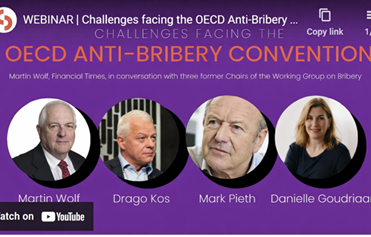
Moderated by Financial Time’s Chief Economics Commentator Martin Wolf, the speakers highlighted several recent, disturbing developments: the U.S. retreat from vigorous enforcement of the Foreign Corrupt Practices Act, the weak anticorruption directives the European Commission has issued, and political interference in high-profile bribery cases in Italy.
At the same time, the three — Mark Pieth, now Professor of Criminal Law, Criminal Procedure and Criminology at the University of Basel; Drago Kos, currently Interim Dean of the International Anti-Corruption Academy; and Danielle Goudriaan, presently partner at a leading Dutch law firm — offered several paths forward.
• Other Nations Stepping Up: Danielle Goudriaan emphasized that the US was never meant to be the world’s sole anti-corruption enforcer, and the solution to the US stepping back is for other member countries to honor their legal commitments. Mark Pieth expressed hope that the rest of the G7 countries will take over this responsibility. Drago Kos noted this is already beginning to happen, with countries like France, the UK, and Switzerland stepping into the enforcement loophole and increasing their efforts.
• Applying Pressure Through the OECD: Pieth argued that the OECD Working Group on Bribery must fulfill its duty to follow up on allegations of political interference and hold member countries accountable. He highlighted that “naming and shaming” offending countries can be a highly effective tool, citing past successes where the Working Group’s pressure forced the UK and Sweden to reverse politically motivated decisions to drop bribery cases.
• Protecting Prosecutorial Independence: Goudriaan stressed the critical need to protect prosecutorial discretion to ensure effective enforcement. To realistically prosecute complex international bribery schemes, prosecutors must be free to make good-faith decisions based on cumulative circumstantial evidence without the “chilling effect” of facing personal criminal liability for their legal strategies.
• Leveraging Civil Society: The panel highlighted the importance NGOs in the enforcement ecosystem. Goudriaan suggested that NGOs can play a vital role in flagging ad-hoc issues and red flags between the OECD’s formal monitoring cycles. Kos added that involving civil society and the private sector in the drafting of legal guidelines significantly improves the quality and effectiveness of anti-corruption instruments.
• Maintaining Corporate Compliance: Despite the troubling political landscape, Goudriaan noted that many private companies plan to weather the storm rather than abandon their ethics. In her private legal practice, she sees companies deciding not to change their compliant ways of doing business, viewing this as a passing phase rather than a permanent shift.
• Expanding Frameworks in Developing Regions: Goudriaan pointed out that countries currently preparing to join the European Union are actively busy upgrading their anti-corruption frameworks up to standard, providing a “bright spot” for global enforcement. Furthermore, Kos noted that countries in Africa and the Gulf region are currently showing a growing interest in developing anticorruption measures.
The webinar was organized by four NGOs: Hawkmoth (The Netherlands), HEDA (Nigeria), Corner House (UK), and ReCommon (Italy).
 GAB | The Global Anticorruption Blog