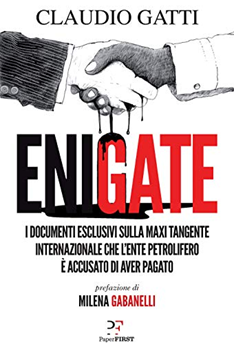
A courageous Italian judge has affirmed that the evidence showing oil giant ENI paid massive bribes for rights to Nigerian oil block OPL-245 is reliable. Judge Francesca Giacomini ruled in December that ENIgate, a book reporting the bribery scheme, was based on “multiple reliable sources.”
In her opinion she not only dismissed ENI’s lawsuit that author Claudio Gatti and publisher Il Fatto (“the Fact”) had defamed the company by claiming it had paid bribes but ordered it to pay defendants’ legal fees as well.
Saying OPL-245 was secured through bribery isn’t what makes Judge Giacomini courageous. The bribery has been a matter of public record for over a decade (here).
The judge merits the accolade for having the fortitude to say so in the face of the fecklessness and likely downright corruption of her judicial colleagues (here). On even more evidence than she had before her, three of them exonerated ENI, its executives, and accomplices of all bribery charges with the flimsiest of reasoning (here). Even more scandalous, in a separate case a fourth found the prosecutors guilty of a crime for how they chose to present the case.
That case rests on an imagined set of facts and an unprecedented interpretation of Italian law (here). Is it too much to hope that the court hearing the appeal show the same courage as Judge Giacomini?
Time for English translation?
Key excerpts of Judge Giacomini’s ruling in English, courtesy of Google and Microsoft office translation programs, below. Full text of decision here.
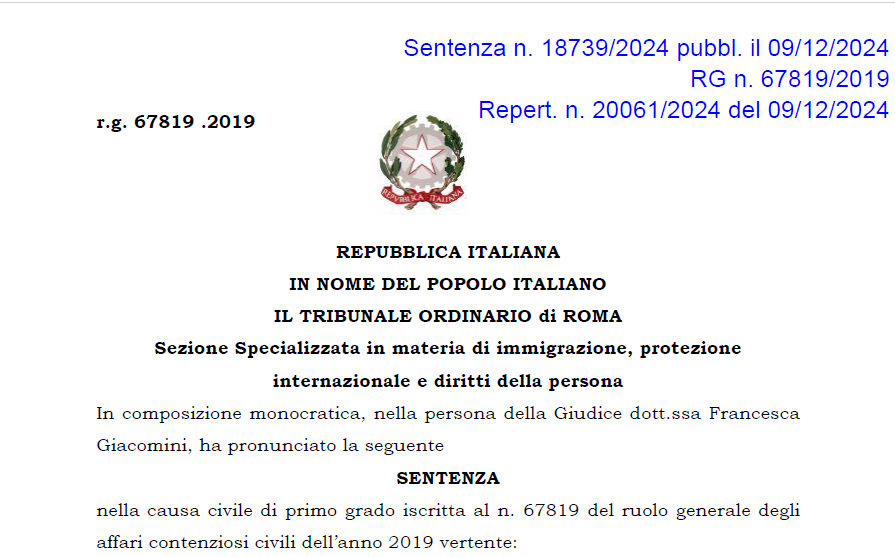
(Machine translation excerpts)
“In particular, according to the plaintiff’s submission. . .Gatti’s book suggests that ENI would have paid, availing itself of mediation of Mr. Obi and through the Malabu company, a “maxi-bribe” to Nigerian officials (“corrupt bigwigs of the Nigerian political class”) in order to obtain exploration rights relating to Block 245. . . [it also gives] the reader the conviction that Malabu’s involvement in the Nigerian affair was solely aimed at enabling ENI to pay former Oil Minister Dan Etete (who was, according to the author of the book, the real owner) “the largest bribe ever”.”The book turns out to be the result of a long-standing and in-depth knowledge of the story, based on the autonomous and direct collection of the news through investigations and inquiries carried out first-hand, then fully elaborated.
“[F]rom an examination of the case documents it is clear that – far from a representation of the story of the purchase of exploration rights for Block 245 in an “incorrect, incomplete, and misleading” manner, providing the reader with a “false representation of reality” – there was a broad coincidence between the conclusions reached by the author of the book regarding the activities carried out by today’s plaintiff in this context, and the charges that the Public Prosecutor’s Office in Milan will subsequently formulate against ENI and its executives.
“Therefore, the correct contextualization of the phrases and sentences that ENI assumes to be false and damaging to its reputation, in reality refer to facts and circumstances whose fundamental core is confirmed by the procedural acts, which have as their object the same story from which the entire work of Gatti draws its cue; a work in which, in a timely manner, the author reports the sources from which the statements were taken and the circumstances reported, correctly interpreting some of them in a dubious form, where the sources are contradictory or the versions of the interviewees have changed over time (see, in particular, what is stated by the defendant in relation to Armanna’s statements).
“The reconstruction of the facts reported in the pages of the book and the subject of the case is therefore based on multiple reliable sources (interviews with the protagonists of the affair such as Armanna and Zigales; official documents; email exchanges between the top management and between them and representatives of the Nigerian companies involved) which are punctually cited by the author and which confirm, for the purposes and within the limits of the present proceedings, how the facts attributed to the plaintiff and the subject of the critical reconstruction of the author of the book are truthful from the point of view of putative truth at least.”
 GAB | The Global Anticorruption Blog
That is an interesting outcome given previous judicial rulings. How can this be used to get the prosecutors out of jail? The impunity of locking up innocent prosecutors while those involved in trading influence and foreign bribery walk free is appalling.
Pingback: Italian Prosecutors’ Criminal Conviction For Not Disclosing Information in OPL-245 Bribery Case Called A Travesty of Justice | GAB | The Global Anticorruption Blog