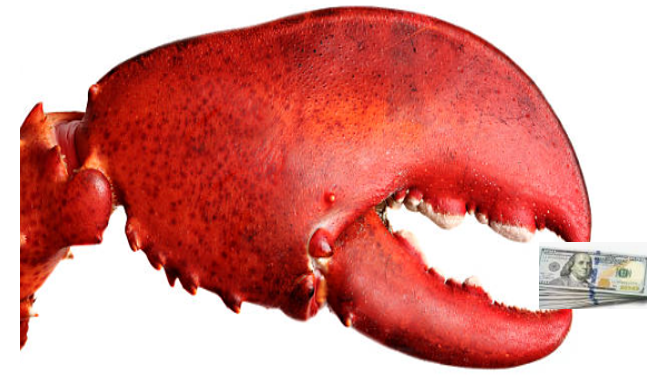
For more than three decades the U.S. Justice Department has sought ways to pressure American corporations to police their executives, employees, and consultants. To see that they take measures to see those they employ don’t pay bribes, rig prices, or commit other crimes. Shown above is pictorial representation of its latest tool.
It shows a crab gripping a stack of hundred dollar bills with its claw. That is precisely what the Justice Department expects a corporation to do if it discovers someone in its employ has paid a bribe, fixed a price, or committed another serious crime to advance the corporation’s interest. The company is to clawback monies paid the miscreant.
Like the promulgation of a business code of ethics, regular training on the code, and other prevention policies, the Department doesn’t require companies subject to its jurisdiction to have a clawback policy. But those that do can expect leniency up to and including the dismissal of any charges against it arising from an employee or consultant’s criminal conduct while serving the corporation’s interest.
The clawback policy was announced in a September 2022 memo by Deputy Attorney General Lisa Monaco. Its first application appears to be in a three-year non-prosecution agreement in September 2023 with the specialty chemicals manufacturing company Albermarle. The company was charged with bribing officials in several Asian countries; the fine paid to resolve the case was reduced by $763,453, the amount of bonuses due to employees involved in the bribery that it clawedback.
 GAB | The Global Anticorruption Blog